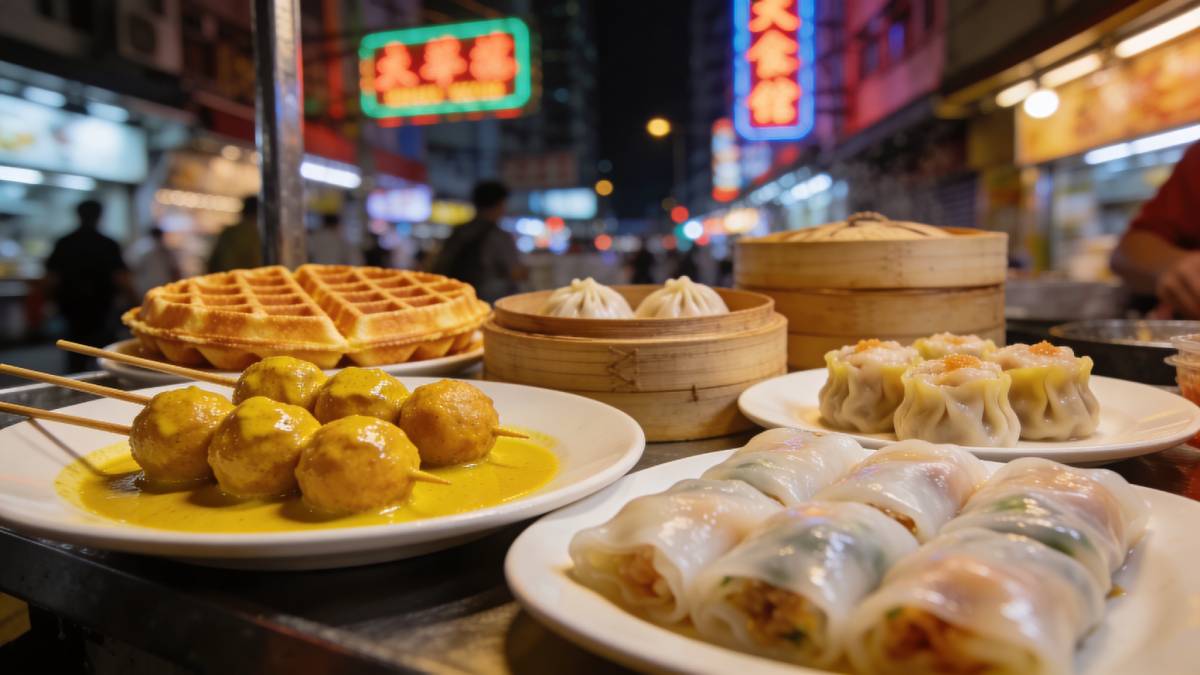
Hong Kong's essential street food costs almost nothing and is sold within a few streets of each MTR station: curry fish balls for HK$15 to HK$20 a skewer, an egg waffle for HK$17 to HK$28, siu mai and cheung fun for around HK$15, and a plate of wok-fried something at one of the city's last dai pai dong for under HK$100. The best hunting grounds are Mong Kok for snacks, Sham Shui Po for value, and Central and Wan Chai for the surviving open-air stalls. This guide lists the dishes, the 2026 prices, the streets and how to order.
Which dishes should you try first?
| Dish | Cantonese | What it is | Typical price (2026) | Where |
|---|---|---|---|---|
| Curry fish balls | 咖喱魚蛋 (ga lei yu daan) | Springy fish-paste balls in mild yellow curry, five to a skewer | HK$15 to 20 | Everywhere; Fa Yuen Street, Mong Kok |
| Egg waffle | 雞蛋仔 (gai daan zai) | Crisp, puffy honeycomb waffle, plain or with chocolate, matcha or cheese | HK$17 to 28 | Mong Kok, Causeway Bay, North Point |
| Siu mai on a stick | 燒賣 | Street-style pork and fish dumplings with soy and chilli oil | HK$10 to 15 | Any snack stall |
| Cheung fun | 腸粉 | Rolled rice noodle with sweet soy, sesame and hoisin | HK$10 to 15 | Sham Shui Po, Mong Kok |
| Three stuffed treasures | 煎釀三寶 | Fish paste stuffed into pepper, aubergine and tofu, pan-fried | HK$12 to 20 | Mong Kok, Kwun Tong |
| Stinky tofu | 臭豆腐 | Fermented tofu deep-fried, with sweet sauce and chilli | HK$15 to 25 | Mong Kok, Sham Shui Po |
| Put chai ko | 砵仔糕 | Steamed brown sugar or coconut pudding with red beans, on two bamboo sticks | HK$8 to 12 | Sham Shui Po, Yau Ma Tei |
| Tofu fa | 豆腐花 | Silken tofu pudding with ginger or brown sugar syrup | HK$10 to 18 | Yau Ma Tei, Sham Shui Po |
| Pineapple bun with butter | 菠蘿油 | Crisp-topped bun with a slab of cold butter, from a cha chaan teng | HK$12 to 20 | Any cha chaan teng |
| Dai pai dong stir-fry | 大牌檔小炒 | Wok-fried clams, beef with rice noodles, salt and pepper squid | HK$60 to 120 per dish | Stanley Street Central, Cross Street Wan Chai, cooked food centres |
Prices are typical stall prices observed in 2026; Hong Kong Cheapo's street food guide (updated June 2026) puts curry fish balls at HK$15 to 20 for five and egg waffles at HK$17 to 28. Expect a few dollars more in Central and Causeway Bay than in Sham Shui Po.
Where do locals go for street food?
Mong Kok
The snack capital. Fa Yuen Street, Tung Choi Street (Ladies' Market) and the lanes off Dundas Street are lined with stalls selling fish balls, waffles, stuffed treasures and grilled squid from late morning until past midnight. Come hungry after the markets and graze.
Sham Shui Po
The neighbourhood food writers send each other to. Kweilin Street and Fuk Wing Street for snacks and old-school noodle shops, and the cooked food centre above Pei Ho Street Market for congee, roast meats and wok dishes at the lowest prices in the city. Sham Shui Po's Michelin Bib Gourmand noodle shops are here too.
Central
The cluster of dai pai dong on Stanley Street and Graham Street, a few minutes from the Mid-Levels escalator, is the most photographed. Sing Heung Yuen's tomato soup noodles and the wok hei stir-fries at the neighbouring stalls draw office workers at lunch and everyone else at night.
Wan Chai
Cross Street and Tai Wong Street East around the wet market keep a working-class food scene going next to the office towers: rice rolls, roast goose rice and a couple of open-air stalls that survived redevelopment.
North Point
Marble Road market and Chun Yeung Street, where the tram runs through the wet market, plus the cooked food centre in the Java Road Municipal Services Building. Fewer tourists, same food.
Tsim Sha Tsui
The Haiphong Road Temporary Market cooked food centre, with its iron roof and red lampshades, has nine stalls that the Hong Kong Tourism Board lists among the essential dai pai dong: satay beef noodles, claypot milk tea, Hainanese chicken rice.
What is a dai pai dong, and how many are left?
Dai pai dong are the open-air licensed cooked food stalls that fed post-war Hong Kong. The government stopped issuing new licences in the 1950s and allowed existing ones to pass only to a spouse, so the number has fallen for decades: the Food and Environmental Hygiene Department counted 17 remaining in July 2024, down from 25 in 2014. The surviving stalls are concentrated in Central, Sham Shui Po and Wan Chai. The same cooking, and often the same families, continue indoors in the cooked food centres the government built above its wet markets, which is where most of the city now eats this way.
If you want the food with a seat and a Michelin nod, the 2026 Bib Gourmand list names 70 good-value eateries in Hong Kong, many of them noodle and dim sum shops within a few streets of the stalls above. Portal Hong Kong lists several: Mak Man Kee for wonton noodles in Jordan, Tim Ho Wan for dim sum, and Kam Fai for old-style dim sum.
How do you order, and what does it cost to eat for a day?
- Point and count. At snack stalls you point at the tray and say how many skewers. Sauce is added on top: sweet, curry, mustard or chilli. Say "少辣" (siu laat) for less chilli.
- Pay as you go. Most stalls charge at the counter before handing over the food. Octopus is widely accepted now but not universal; keep HK$20 and HK$50 notes.
- At a dai pai dong, share. Order three or four dishes for the table with rice; the bill for two is usually HK$150 to HK$250 including drinks.
- Budget: a snack crawl through Mong Kok runs HK$60 to HK$100 a person; a dai pai dong dinner HK$80 to HK$150 a head. Cheaper than any sit-down restaurant in the city, and often better.
For more places to eat, browse the dim sum, noodle and Cantonese categories, or start from the district pages above.
Frequently asked questions
- What is the most famous street food in Hong Kong?
- Curry fish balls, sold on a skewer in a mild yellow curry sauce for about HK$15 to HK$20 per five, followed by the egg waffle (gai daan zai), a crisp honeycomb-shaped waffle for HK$17 to HK$28 depending on flavour. Siu mai on a stick, cheung fun with sweet sauce and three stuffed treasures are the rest of the classic set.
- How much does street food cost in Hong Kong in 2026?
- Most skewer and snack items are HK$10 to HK$30. A full dai pai dong meal with a couple of stir-fried dishes and rice is HK$80 to HK$150 a head. You can eat very well for under HK$100 a day if you stick to stalls and cooked food centres.
- Where is the best street food in Hong Kong?
- Mong Kok, around Fa Yuen Street, Tung Choi Street and Dundas Street, has the highest concentration of snack stalls. Sham Shui Po (Kweilin Street, Fuk Wing Street and the Pei Ho Street cooked food centre) is the local favourite for value. Central's Stanley Street and Wan Chai's Cross Street have the surviving dai pai dong. North Point's Marble Road market and Kwun Tong are good outside the tourist areas.
- What is a dai pai dong?
- A licensed open-air cooked food stall, named after the large licence plate ('dai pai') the operator displayed. Hong Kong stopped issuing new licences decades ago, and the Food and Environmental Hygiene Department counted only 17 remaining by mid-2024. The same style of wok cooking continues indoors in the government-run cooked food centres above wet markets.
- Do street food stalls take Octopus or cards?
- Many now take Octopus and the mainland mobile wallets, but a good number are still cash only, especially the older stalls and the Jade Market-style hawkers. Carry HK$20 and HK$50 notes and coins.
- Is Hong Kong street food safe to eat?
- Yes. Stalls are licensed and inspected by the Food and Environmental Hygiene Department, turnover is high and most food is cooked to order in front of you. Pick the busy stall, eat hot food hot, and treat raw-looking cold items with the same caution you would anywhere.