Quick Answer: Sham Shui Po is Hong Kong's trade-by-the-street district: electronics and second-hand gear on Apliu Street, computers in the Golden arcades, fabric on Ki Lung Street, buttons and ribbon on Yu Chau Street, leather on Tai Nan Street and toys on Fuk Wing Street. It is also the cheapest serious eating in Kowloon. Here is what is on which street and how to get there.
Sham Shui Po is the district where Hong Kong still trades by the street. Electronics, tools and second-hand gear on Apliu Street; computers in the Golden arcades and Dragon Centre; fabric on Ki Lung Street; buttons, ribbon and zips on Yu Chau Street; leather and hardware on Tai Nan Street; toys and party goods on Fuk Wing Street; and the wet market and cooked food centre on Pei Ho Street. It is also the cheapest serious eating in Kowloon. This guide covers what is on which street, the electronics and fabric trades, the food, how to get there and what the area is like. Portal Hong Kong lists businesses in Sham Shui Po by category.
What is on which street?
| Street or building | Trade | Notes |
|---|---|---|
| Apliu Street | Electronics, cables, adaptors, tools, audio, cameras, phone parts, second-hand gear | Stalls and shops, busiest from early afternoon; station Exit C2 |
| Golden Computer Arcade and Golden Computer Centre, Fuk Wa Street | Computers, components, software, repairs | Basement and upper-floor warren; check model and warranty |
| Dragon Centre, Yen Chow Street | Electronics, phones, hobby shops, food court | Air-conditioned and multi-storey, the district's mall |
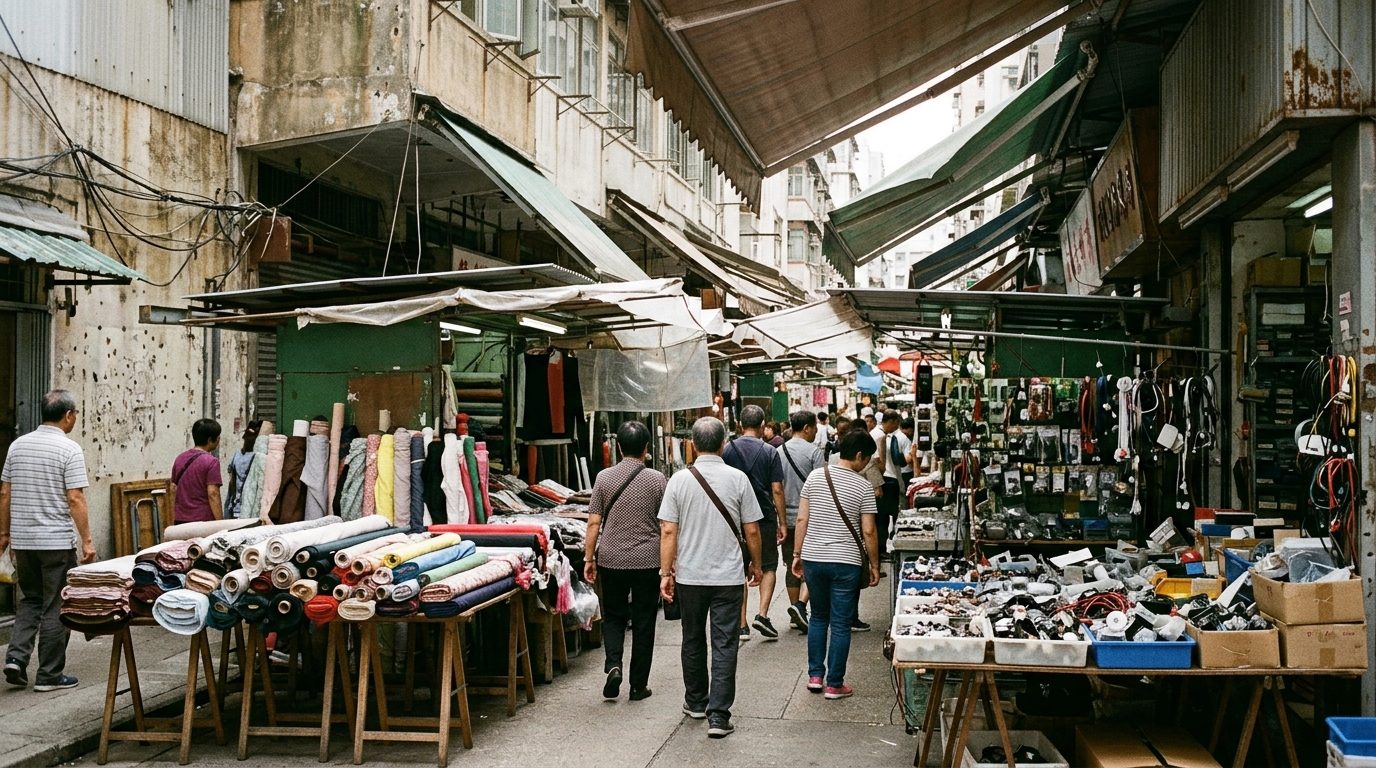
| Ki Lung Street | Fabric: rolls of cloth cut to length | The fabric street; shop hours, closed early evening |
| Yu Chau Street | Buttons, zips, ribbon, lace, beads, trimmings | Runs parallel to Ki Lung Street |
| Tai Nan Street | Leather, hardware, sewing supplies, newer coffee shops | The slow end of the district's regeneration |
| Fuk Wing Street | Toys, party goods, packaging | Known locally as toy street |
| Pei Ho Street | Wet market below, cooked food centre above | Morning for the market, all day for the food |
| Cheung Sha Wan Road | Wholesale fashion and garment showrooms | Trade-oriented; some shops sell retail |
How do you get there and around?
Sham Shui Po station sits under Cheung Sha Wan Road on the MTR Tsuen Wan line, one stop north of Prince Edward and one south of Cheung Sha Wan, which puts Mong Kok two stops away and Tsim Sha Tsui about ten minutes. Exit C2 comes up on Apliu Street itself. Nam Cheong station, ten minutes' walk west, is on the Tung Chung and Tuen Ma lines and is the useful interchange for the western New Territories and the airport corridor. Buses and minibuses run along Cheung Sha Wan Road and Lai Chi Kok Road to the rest of Kowloon. The street grid is regular and the market streets run parallel to each other, so navigation is simple once you know which trade you want; the whole market area is about fifteen minutes end to end on foot.
What should you see?
- Apliu Street, for the second-hand stalls as much as the shops.
- Ki Lung Street and Yu Chau Street, for fabric, buttons and trimmings by the metre and the box.
- The Golden arcades, for parts, repairs and prices the chain stores do not match.
- Fuk Wing Street, for toys and party supplies at wholesale-adjacent prices.
- Pei Ho Street cooked food centre, for lunch above a wet market.
- Lei Cheng Uk Han Tomb, an Eastern Han brick tomb discovered in 1955 and declared a monument in 1988, now a museum.
Where do you eat and shop?
Sham Shui Po is where Hong Kong eats cheaply and well. Rice noodle rolls and congee for breakfast, wonton noodles and beef brisket at lunch, roast meat rice from the shopfront ovens, claypot rice in the colder months, tofu pudding and traditional desserts afterwards, and cha chaan teng on every block for milk tea and set meals. The Pei Ho Street cooked food centre is the concentrated version, and the stalls around Kweilin Street handle the snacks. For the food itself, read the Hong Kong street food crash course and the dim sum guide. Shopping follows the street table above, and the rule is the same everywhere in the district: check the model, the condition and the warranty before paying, particularly on second-hand electronics. Browse markets, electronics, shopping and restaurant listings, and Langham Place two stops south if you want a mall instead.
Who does business here, and who does the area suit?
Wholesale and retail trade above all: electronics, components, fabric, haberdashery, leather, toys, packaging and garment supply, much of it run from single shopfronts by the families that own them. Above the shops sit small trading companies, repair workshops, accountancy practices and the service businesses that keep them going. Rents are among the lowest in urban Kowloon, which is what keeps the trades here and what has drawn a slow drift of studios, coffee shops and design businesses into Tai Nan Street and the surrounding blocks. The area suits makers, traders and anyone who would rather buy a part than replace a whole; it suits people who want quiet or new buildings much less. South is Mong Kok and beyond it Tsim Sha Tsui, and for more of the same territory the five neighbourhoods guide is the companion piece. For renting in the district, see the guide to renting an apartment in Hong Kong.
Frequently asked questions
- What is Sham Shui Po known for?
- Specialist street markets, each with its own trade. Apliu Street sells electronics, tools, cables and second-hand gear; Ki Lung Street sells fabric; Yu Chau Street sells buttons, ribbon, zips and beads; Tai Nan Street sells leather and hardware; Fuk Wing Street sells toys and party goods; and Pei Ho Street has the wet market and cooked food centre. The Golden Computer Arcade and Dragon Centre cover computers and electronics indoors.
- How do I get to Sham Shui Po?
- Sham Shui Po station on the MTR Tsuen Wan line, one stop north of Prince Edward and one stop south of Cheung Sha Wan. Exit C2 comes up on Apliu Street. Nam Cheong station on the Tung Chung and Tuen Ma lines is a ten-minute walk west and covers the western New Territories and the airport corridor. Buses and minibuses run along Cheung Sha Wan Road and Lai Chi Kok Road.
- Where is the electronics market in Sham Shui Po?
- Apliu Street, running between Nam Cheong Street and Yen Chow Street, with the densest stretch near Sham Shui Po station Exit C2. Stalls and shops sell cables, adaptors, tools, audio gear, cameras, phone parts and a great deal of second-hand equipment. For computers, the Golden Computer Arcade and Golden Computer Centre on Fuk Wa Street and Dragon Centre on Yen Chow Street are the indoor equivalents.
- Where do you buy fabric in Hong Kong?
- Sham Shui Po. Ki Lung Street is the fabric street, with rolls of cloth stacked on the pavement and shops that will cut to length. Yu Chau Street next to it handles buttons, zips, ribbon, lace, beads and trimmings, and Tai Nan Street covers leather and hardware. The trade has served Hong Kong's garment industry for decades and is now used heavily by students, designers and home sewers.
- Where do people eat in Sham Shui Po?
- On the street and in the cha chaan teng. The district is known for cheap, serious food: rice noodle rolls, congee, wonton noodles, beef brisket, roast meat rice, claypot rice in the colder months, tofu pudding and traditional Chinese desserts. The Pei Ho Street cooked food centre sits above the wet market. Prices are among the lowest of any urban district in Hong Kong.
- Is Sham Shui Po worth visiting?
- Yes, if you want working Hong Kong rather than the shopping-mall version. It is the district for materials, parts, repairs and food, and it repays an afternoon on foot because the trades are laid out street by street. Lei Cheng Uk Han Tomb, an Eastern Han brick tomb discovered in 1955 and declared a monument in 1988, is a short walk north and is now a museum.
- What is Sham Shui Po like as a place to live?
- Dense, old and cheap by Hong Kong standards, with a mix of pre-war shophouses, 1960s walk-ups, public estates and newer towers near Nam Cheong. Rents are among the lowest in urban Kowloon and the MTR puts Tsim Sha Tsui about ten minutes away. The trade-off is older building stock, small flats and a district that is busy and noisy through most of the day.