Quick Answer: Hong Kong had 333 hotels with 93,456 rooms in July 2026, plus 1,222 licensed guesthouses with 12,604 rooms. The Tourism Board puts the average achieved room rate for January to July 2026 at HK$2,286 for High Tariff A hotels, HK$1,013 for High Tariff B, HK$593 for medium tariff and HK$326 for guesthouses. Tsim Sha Tsui has the most rooms; Yau Ma Tei and Mong Kok are the fullest.
Hong Kong had 333 hotels with 93,456 rooms in July 2026, plus 1,222 licensed guesthouses holding another 12,604 rooms, according to the Hong Kong Tourism Board's monthly hotel room occupancy report. Average achieved room rates for January to July 2026 ran from HK$2,286 in the top tariff band down to HK$593 in mid-market hotels and HK$326 in guesthouses. Where you stay changes the price more than the season does. This guide compares the six districts visitors actually choose between, gives the published 2026 rates and occupancy, explains the guesthouse licence and how to check one, and covers the airport link. Properties are listed under hotels, luxury hotels, boutique hotels and guest houses, and by area under district.
How do the districts differ?
- Central is the banking core: the highest concentration of flagship hotels, the Mid-Levels escalator, Soho restaurants and the fastest airport link. Quiet at weekends. See the Central district guide.
- Sheung Wan sits one stop west: dried seafood shops, galleries and smaller design-led hotels such as Ovolo Sheung Wan. Cheaper than Central and walkable to it. See the Sheung Wan guide.
- Wan Chai mixes the convention centre, offices and old street markets, and is the usual base for exhibition visitors. See the Wan Chai guide.
- Causeway Bay is shopping and late-night eating, dense and loud, and typically a step down in price from Central for a comparable room.
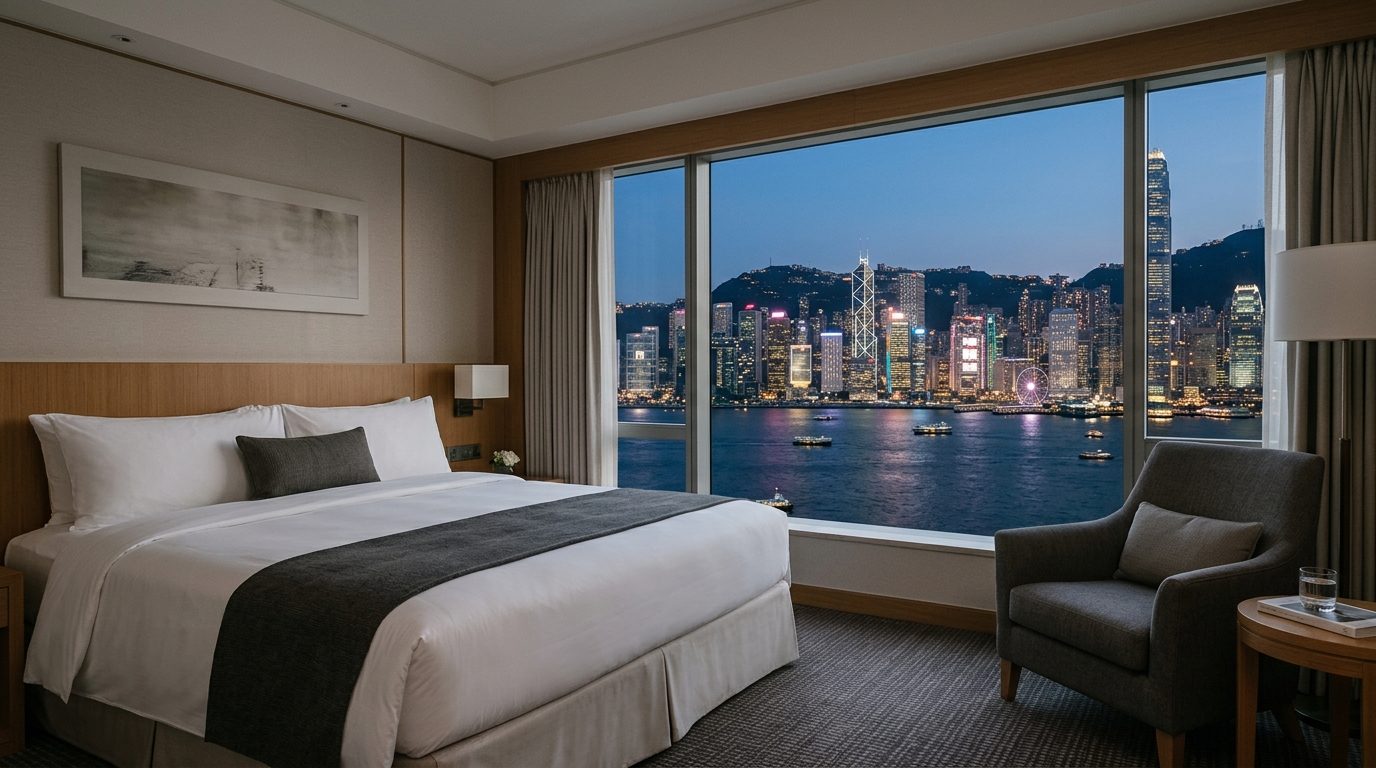
- Tsim Sha Tsui, across the harbour in Kowloon, has the harbour-front views, the museums and the biggest room supply in the city, from The Peninsula and Rosewood down to budget guesthouses. See the Tsim Sha Tsui guide.
- Mong Kok and Yau Ma Tei are the cheapest and busiest: street markets, small hotels, and the best access to the street food. See the Mong Kok guide.
What do rooms cost in 2026?
The Tourism Board publishes average achieved room rate by tariff category, not by district, so the table below is the honest version of the price question. Figures are from the Hotel Room Occupancy Report for July 2026, published August 2026 and checked 16 September 2026. July 2026 figures are provisional. Rates exclude government tax and non-room items such as food, laundry and airport transfers.
| Category | Average achieved room rate, Jan-Jul 2026 | July 2026 | Typical districts |
|---|---|---|---|
| High Tariff A hotels | HK$2,286 | HK$2,081 | Central, Tsim Sha Tsui harbourfront, Admiralty |
| High Tariff B hotels | HK$1,013 | HK$956 | Wan Chai, Causeway Bay, Sheung Wan, inland Tsim Sha Tsui |
| Medium tariff hotels | HK$593 | HK$578 | Mong Kok, Yau Ma Tei, outer Kowloon, New Territories |
| All hotels | HK$1,297 | HK$1,205 | Citywide |
| Licensed guesthouses | HK$326 | HK$309 | Tsim Sha Tsui, Yau Ma Tei, Mong Kok |
Rates were rising through 2026: the all-hotel average for January to July was 7.4% above the same period in 2025, while guesthouse rates fell 9.2%. Individual hotels sell at dynamic daily prices, so no property publishes a fixed room rate, and any single quoted figure for a named hotel is a snapshot rather than a tariff.
Where are the rooms, and how full are they?
| District (Tourism Board grouping) | Hotels, July 2026 | Rooms | Occupancy, July 2026 |
|---|---|---|---|
| Tsim Sha Tsui | 61 | 18,642 | 89% |
| New Territories | 33 | 16,516 | 90% |
| Other Kowloon | 35 | 13,332 | 92% |
| Wan Chai (includes Causeway Bay) | 56 | 11,925 | 88% |
| Central and Western (includes Sheung Wan) | 57 | 9,620 | 87% |
| Eastern and Southern Hong Kong | 29 | 8,566 | 92% |
| Yau Ma Tei and Mong Kok | 47 | 7,178 | 95% |
| Islands | 15 | 7,677 | 79% |
Two points worth noting before booking. The Tourism Board folds Causeway Bay into Wan Chai district and Sheung Wan into Central and Western, so those two rows cover more ground than the names suggest. And the cheap districts are the full ones: Yau Ma Tei and Mong Kok ran at 95% in July 2026, so late booking there is riskier than late booking in Central.
Is the guesthouse licensed?
Under the Hotel and Guesthouse Accommodation Ordinance, any premises held out as providing sleeping accommodation for a fee needs a licence unless every letting runs for at least 28 continuous days. That covers small walk-ups in Tsim Sha Tsui as much as it covers the Mandarin Oriental. Licensed guesthouses are barred from using "Hotel" in their business name, on signboards or in online advertising, so a two-floor operation calling itself a hotel is a signal to check.
Check the licence on the Licensing Authority's search for all premises types of hotels and guesthouses, by licence number, name, address, district or end of licence period, or use the free "Hong Kong Licensed Hotels and Guesthouses" mobile app. Since the 2020 amendment ordinance, running an unlicensed hotel or guesthouse carries a maximum fine of HK$500,000 and three years' imprisonment, up from HK$200,000 and two years, and the authority can apply for a six-month closure order after a second conviction within 16 months, as set out in the Licensing Authority's licensing FAQ. Licensed budget options do exist: Booth Lodge and City Garden Hotel are among the listings under hotels and accommodation.
How do you get around?
The Airport Express reaches Central in 24 minutes, with trains about every 10 minutes from 05:54 to 00:48. Adult Octopus singles are HK$120 to Hong Kong Station, HK$105 to Kowloon Station and HK$73 to Tsing Yi, per the Airport Authority's Airport Express page, checked 16 September 2026; a Smart Ticket single costs HK$130, HK$115 and HK$80. In-town check-in is available at Hong Kong Station and Kowloon Station. Once in the city, an Octopus card covers the MTR, buses, trams and the Star Ferry, which is the cheapest way to cross between Tsim Sha Tsui and Central. If shopping is the point of the trip, read where to buy gold jewellery before you go.
Frequently asked questions
- Which district is best to stay in Hong Kong?
- It depends on the trip. Tsim Sha Tsui suits first visits: it has the most hotel rooms in the city, the harbour views, the museums and direct MTR and Star Ferry links to Hong Kong Island. Central and Sheung Wan suit business travel and eating out. Causeway Bay and Wan Chai are the shopping and nightlife base and usually cost less than Central. Mong Kok and Yau Ma Tei are the cheapest of the six and the most crowded.
- How much does a hotel room cost in Hong Kong in 2026?
- The Hong Kong Tourism Board's hotel room occupancy report puts the average achieved room rate for January to July 2026 at HK$2,286 for High Tariff A hotels, HK$1,013 for High Tariff B, HK$593 for medium tariff hotels and HK$326 for licensed guesthouses, with an all-hotel average of HK$1,297. Those are averages actually achieved across responding hotels, excluding government tax and any food, laundry or transfer charges built into a rate.
- What is a licensed guesthouse in Hong Kong?
- Under the Hotel and Guesthouse Accommodation Ordinance, premises held out as providing sleeping accommodation to anyone willing to pay a fee are a hotel or guesthouse and need a licence, unless every letting is for a minimum of 28 continuous days. Guesthouses are licensed separately from hotels and are barred from using the word "Hotel" in their business name, on signboards or in online advertising. In July 2026 there were 1,222 licensed guesthouses with 12,604 rooms.
- How do I check a Hong Kong guesthouse licence?
- The Office of the Licensing Authority under the Home Affairs Department runs a public search covering all premises types, where you can look up a licence number, a name, an address, a district or the end of the licence period. There is also a free mobile application, Hong Kong Licensed Hotels and Guesthouses. Check before you pay, and treat any small operator calling itself a hotel as a warning sign, since guesthouses may not use that word.
- What happens if a guesthouse is unlicensed?
- Operating an unlicensed hotel or guesthouse carries a maximum fine of HK$500,000 and three years' imprisonment, raised from HK$200,000 and two years under the 2020 amendment ordinance. The same amendment created a strict liability offence that makes owners and tenants of the premises criminally liable, and lets the authority apply for a six-month closure order after a second conviction within 16 months in respect of the same premises. Guests are not prosecuted, but a raid can end a stay.
- Which Hong Kong district has the most hotel rooms?
- Tsim Sha Tsui, with 61 hotels and 18,642 rooms in July 2026 on the Tourism Board's count. The New Territories follow with 16,516 rooms, then the rest of Kowloon outside Tsim Sha Tsui and Yau Ma Tei with 13,332, Wan Chai district with 11,925 and Central and Western with 9,620. Yau Ma Tei and Mong Kok together have only 7,178 rooms, which is part of why they run the highest occupancy in the city.
- How do I get from the airport to my hotel?
- The Airport Express reaches Central in 24 minutes, running roughly every 10 minutes from 05:54 to 00:48. Adult single fares by Octopus are HK$120 to Hong Kong Station, HK$105 to Kowloon Station and HK$73 to Tsing Yi; on a Smart Ticket they are HK$130, HK$115 and HK$80. Hong Kong Station and Kowloon Station both offer in-town check-in, so you can drop bags and collect boarding passes before heading back out to the airport.